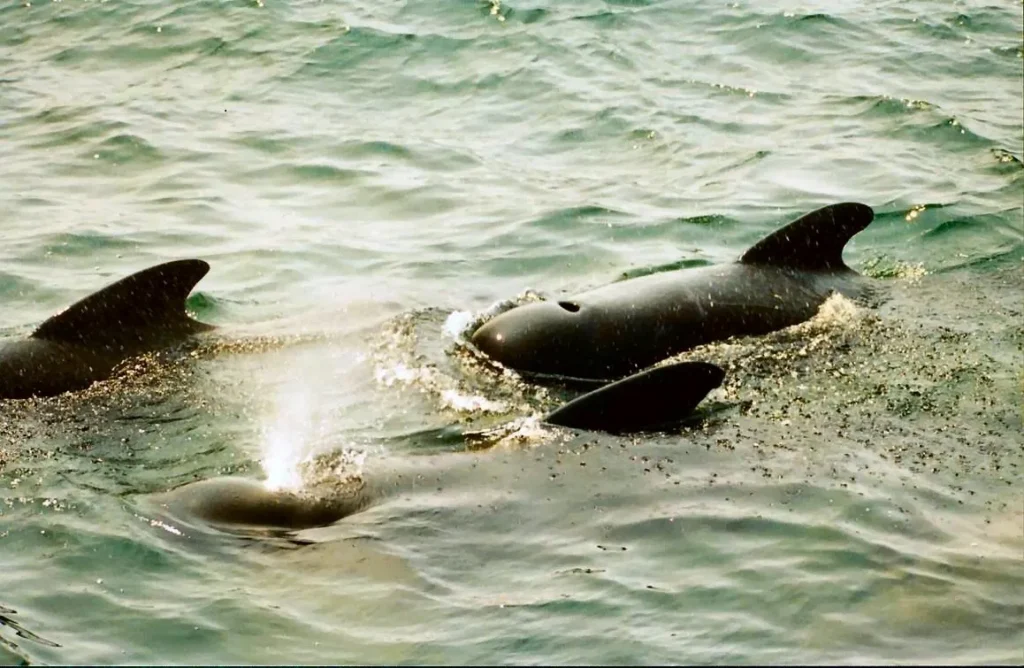
What do you call a whale that can fly? A PILOT whale! *Ba Dum Tss*
Now that I have your attention–no, pilot whales can’t fly airplanes! But their name does have something to do with leading. A long time ago, people believed that pilot whales traveled with one leader who “piloted” or guided the rest of the group, kind of like a ship’s captain or the pilot of a plane. The others would closely follow behind as they swam through the ocean. Today, we now know that pilot whales don’t have just one leader. Instead they stick together and work as a team, like a close-knit family, as they explore and hunt in the deep blue sea. Pretty cool, right?
In this blog post we’re going to dive into the world of long-finned pilot whales (Globicephala melas). Long-finned pilot whales are typically dark gray to black in color, with a lighter, anchor-shaped patch on their bellies. They grow to be about 20-25 feet in length, and have long, slender flippers that help them navigate through colder waters. The long-finned pilot whales are often and easily mistaken for their cousins, the short-finned pilot whales (Globicephala macrorhynchus). While both species look similar at first glance, there are a few key characteristics that help scientists tell them apart:
- Flipper length and shape: The most obvious difference is the size and shape of their pectoral flippers. Long-finned pilot whales, like the name suggests, have much longer flippers (1/5 the length of their body) than short-finned pilot whales (1/6 the length of their body). These long fins are an adaptation that helps long-finned pilot whales move more efficiently through colder, deeper oceans waters. Short-finned pilot whales, on the other hand, have shorter, broader flippers, which help them swim in warmer waters.
- Skull shape: If you look closely at their skulls, long-finned pilot whales have a narrower skull, while the short-finned pilot whales have a shorter and broader skull.
- Tooth Count: Long-finned pilot whales usually have around 32 to 52 teeth, while short-finned pilot whales tend to have fewer–usually around 28 to 36. Having less teeth is likely an adaptation to sucking their prey as opposed to grabbing it.

Long-finned pilot whales are found in the cool, temperate waters of the North Atlantic and the Southern Hemisphere, but unlike their cousins, the short-finned pilot whales, they avoid tropical regions. Their diet consists mainly of squid, although they will eat small fish. These whales are nocturnal foragers, diving 2-12 minutes and as deep as 500 meters (the length of 5 ½ football fields) to hunt. Like many toothed whales, they use echolocation to help them locate food in the dark depths of the ocean.
The highly social, long-finned pilot whales live in matrilineal groups, meaning that the family structure is led by females, and the group is typically composed of mothers and their offspring. The average family size in the North Atlantic is 11 to 14 individuals. Males typically mate during temporary aggregations, when different family groups come together, sometimes forming massive groups of over 100 whales. During these aggregations, long-finned pilot whales may form symbiotic relationships with other species, like Atlantic white-sided dolphins or bottlenose dolphins–where both species benefit from being together–whether by sharing hunting grounds or protecting each other from predators.
Speaking of temporary aggregations, the Whalemobile team had an exciting opportunity this past summer to witness over 100 long-finned pilot whales in the Gulf of Maine, on Jeffreys Ledge! This was especially thrilling as it marked the first time in 10 years that these whales had been spotted on a whale watch in the area. The pod was seen associating with Atlantic white-sided dolphins, bottlenose dolphins, and common dolphins! They displayed fascinating behaviors, such as spy-hopping and breaching, making it feel like a grand family reunion on the water. Our team has been very fortunate, as our whale watching season felt like something you’d see on National Geographic!
The big question was why were they there? As you may noticed, the location of animals is pretty closely linked to where they food is. Since pilot whales primarily eat squid, perhaps squid moved into the area and the all the toothed whales came in following it?
In the Gulf of Maine, long-finned pilot whales play an important role in the ocean’s food web. As apex predators, they help maintain the balance by controlling the populations of squid and fish, ensuring the health of the ecosystem. Now here is a fun challenge: If long-finned pilot whales are at the top of the food chain, what might happen if their population started to decline? How would that impact the entire ocean ecosystem? Think about it–your answer could surprise you!
Unfortunately, pilot whales are a species of whale known for their mass strandings. Our friend Louisa Hawkes is the communications and volunteer coordinator with project Jonah in New Zealand. Recently there have been mass strandings of long-finned pilot whales in New Zealand. Read about Louisa and the work Project Jonah has done to protect these animals!

At The Whalemobile, we believe people protect what they understand—so we bring ocean science to life through stories, hands-on learning, and by bringing a life-sized whale in schools and libraries. To learn more about our programs, visit our website at www.thewhalemobile.com.