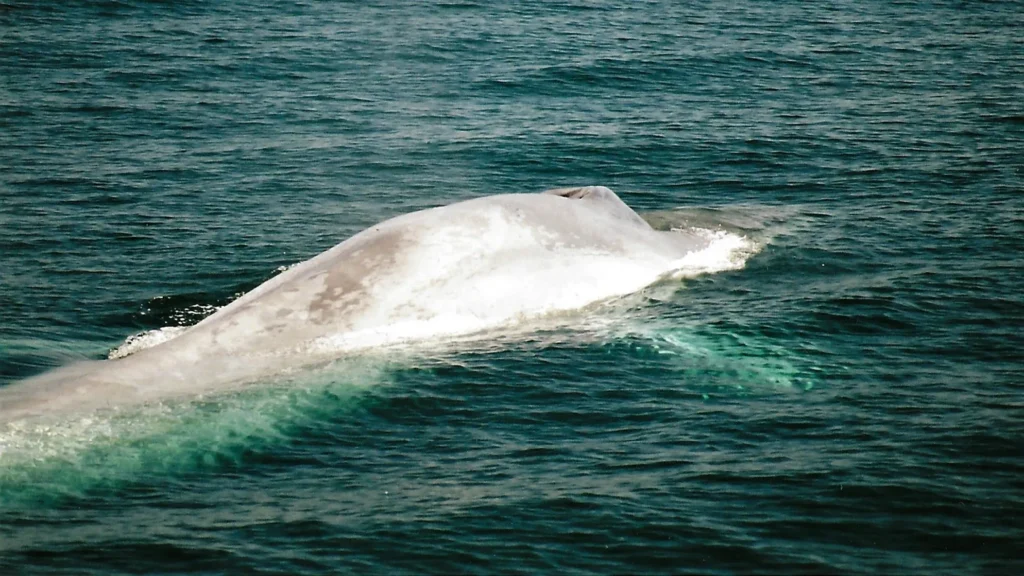
Hey there, ocean explorers! In the previous weeks we’ve talked about some pretty big creatures, like the basking shark, the second largest shark in the world, and the fin whale, the second largest whale in the world. But here’s the big question: What’s the absolute biggest animal on earth? Drumroll please…it’s the mighty blue whale! Bigger than any dinosaur, this ocean giant takes the crown as the largest animal to ever exist. Now grab your goggles, and let’s dive into some splashing fun facts about this amazing ocean superstar.
Blue whales (Balaenoptera musculus) have a stunning bluish-gray coloration, with lighter, mottled spots that make each whale’s pattern unique–like a fingerprint! Their bellies often have a yellowish tint due to microscopic algae called diatoms that cling to their skin, which has inspired their nickname “sulphur whale.” Blue whales have a hydrodynamic shape, meaning their long, smooth bodies are built for gliding gracefully through the water with ease. Although blue whales typically swim at about 5 mph, depending on what they are doing, they can swim up to 20 mph in short bursts.

A blue whale can grow to over 100 feet long–the same length of three school buses lined up bumper to bumper! In fact, the longest blue whale ever recorded was a jaw-dropping 110 feet long, which is like adding an extra mini school bus to the lineup. Not only are these whales long, but they can weigh up to 200 tons, which is equivalent to the weight of 33 African elephants! If that isn’t impressive enough, their hearts are the size of a small car and can weigh over 400 pounds! What’s even more amazing is that blue whales can slow their heart rate to just 1-2 beats per minute when they dive deep into the ocean. This helps them conserve oxygen, allowing them to stay underwater for up to 20 minutes at a time.
If you’ve been following along with our weekly blog posts, you’ve learned that some whales have teeth, while others have baleen. Blue whales are both baleen whales and rorquals, making them a unique group of ocean giants. They use their comb-like baleen plates to filter food from the seawater, while their rorqual features–like expandable ventral pleats of grooves–allow them to gulp enormous amounts of water and krill in one feeding. Despite their massive size, blue whales are specialists in their niche, feeding almost exclusively on krill, which are tiny shrimp-like creatures packed with omega-3 fatty acids. During feeding season, blue whales can consume an astounding 4 tons of krill per day, that is equivalent to the weight of a rhinoceros! It is pretty amazing how the largest animal on earth depends on the tiniest creatures for survival.
Before commercial whaling began, there were estimated to be several hundred thousand blue whales swimming in the world’s oceans. Tragically, decades of intense hunting during the whaling era reduced their population size to near extinction. Today scientists estimate there are only about 10,000 to 25,000 blue whales left globally. In the Gulf of Maine, blue whales are an incredibly rare sight, this is due to an estimated population size of 250-400 individual blue whales in the Western North Atlantic. Although incredibly rare, we had a big influx of krill in the Gulf of Maine this summer (HINT, HINT). July 4th, 2024 was a HUGE day for the Whalemobile team. Can you guess why? Stay tuned for this week’s video about blue whales and learn about our special day!
If you want to learn more about blue whales, read about Asha De Vos, the female Sri Lankan marine biologist who discovered a unique blue whale population:

At The Whalemobile, we believe people protect what they understand—so we bring ocean science to life through stories, hands-on learning, and by bringing a life-sized whale in schools and libraries. To learn more about our programs, visit our website at www.thewhalemobile.com.