It’s sometimes hard to listen to the news about whales. We’ve lost 3 whales that we know of in the past couple weeks–all whales that are familiar to researchers. I’d like to take a minute and introduce them to you!
A new right whale calf (born to Infinity within the last two months) died having been hit by a boat off FL. The calf was first sighted January 17, 2021 off Amelia Island in FL. Right whales have their calves off the coast of GA and FL in the winter months. Aerial surveys are flown every weather permitting day to document and count newborn calves. Calves are critical to the recovery of the right whales as are the breeding females. I went down a rabbit hole looking at the North Atlantic Right Whale Catalog that is put together by the North Atlantic Right Whale Consortium and hosted by the Anderson Cabot Center at the New England Aquarium. I wanted to see who this calf was. Well, it turns out this calf has quite the lineage!
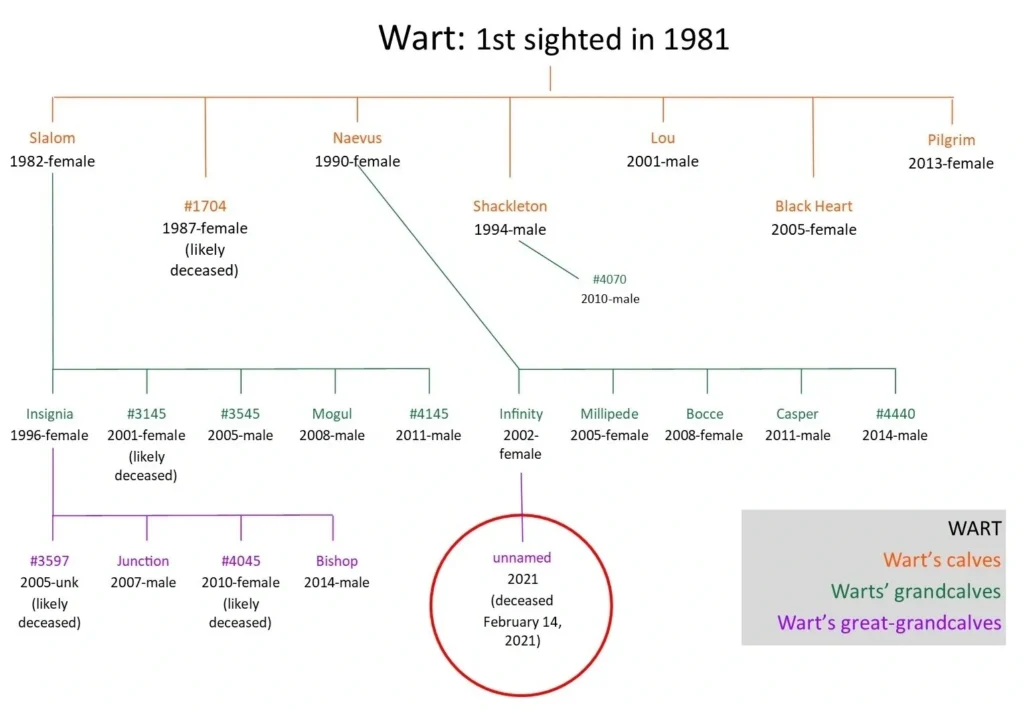
The calf that died is circled in red. She is the great-grandcalf of a well-known whale named Wart. Wart has many stories that can be shared by researchers that have spent time with her. Here’s one from 2013 about when she was unexpectedly seen with a new calf, and another from her unique disentanglement. One of the more notable whales in this lineage is Mogul–he’s been known to venture all over the North Atlantic!
Look at this family tree and think about this for a minute. What if this calf that died was a female? Look at all the whales that one whale, Wart, is responsible for! At least 23! Every whale is critically important, but breeding females especially so! We have to do better.

The next whale is a humpback named Pivot who washed up in MD (cause of death has not been determined). Pivot was first seen in the Gulf of Maine in 2008. She has been sighted many times over the years, and while I don’t remember seeing her, my friends do. One mentioned seeing her breach over 100 times on a trip years ago. Again, a female has died.
Just yesterday, a right whale named Cottontail was reported dead off SC. Cottontail was born in 2009 to whale #3108 (who also hasn’t been sighted for 10 years). Cottontail was seen in Oct. 2020 off Nantucket entangled in fishing gear. He was seen off the coast of FL by a drone operator about 2 weeks ago. His entanglement configuration had changed and he was noticeably thinner and in poorer body condition. Efforts were made to disentangle him by local disentanglement teams, but none were successful. (HBOI, BWRI, and FWC. CMARI provided aerial support.) He had been entangled for at least 4 months.
The thing is…all of this happens out of sight. Michael Moore said in a talk that we would never tolerate a dog being treated like this on the sidewalk–entangled for months at a time dragging around rope and traps. But because it’s whales and we they are out of sight, people don’t see it. But, you know what….it’s in the paper way too often. What do we do? When I was watching the Rover land on Mars, I kept thinking, “We can land a Rover on Mars, but we can’t save right whales!”
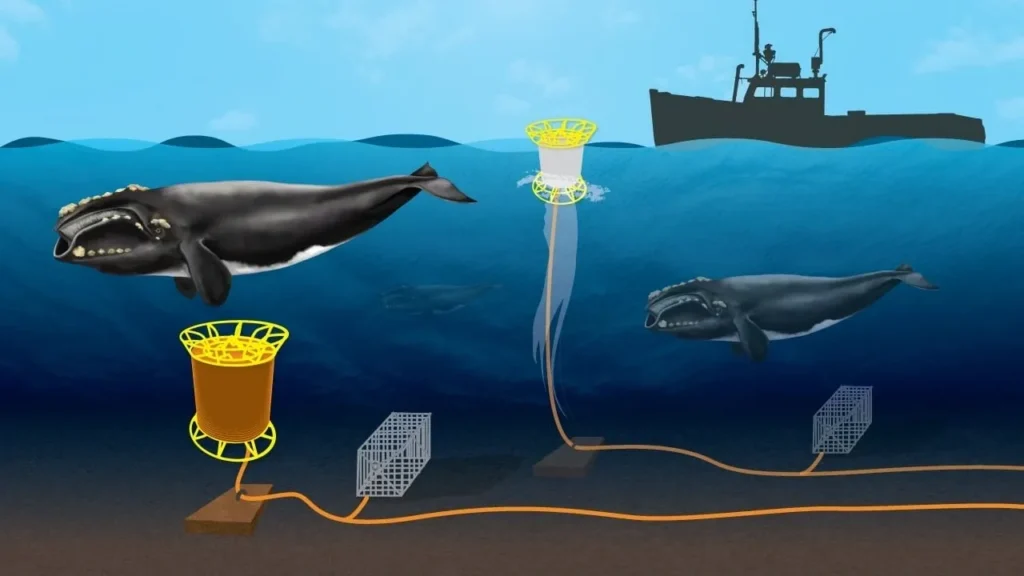
FOLKS, whales are dying because they get entangled in fishing gear. The average time to death is 5 MONTHS. Five months of suffering. Ropeless gear has been shown to work. Fisherman have been testing it. Yes, it’s expensive. Yes, the lobsterman will have to change the way they do things. (93% of the vertical lines in the water in New England are related to lobster traps.) Sometimes that’s what we need to do. I’m sure the teachers didn’t like having to teach virtually, but guess what, they adjusted because that is what was needed to keep everyone safe. I certainly didn’t like my business being shut down with Covid, but I adapted. Now, it’s time to keep the whales safe. Times change, and we are at a critical time for right whales. We need to make changes if we want to save this species. If you like lobster, demand that it is caught with ropeless gear. These animals will become extinct if we don’t.
Ok, deep breath. It’s just really depressing to hear about these animals dying. I wanted to try to humanize them so that people realize that they aren’t these unknown animals out there swimming around. We know more about their familial background in many cases that I do about my own rescue dog.
The takeaway–eat ONLY sustainably caught seafood. Find out where your seafood comes from–ask your grocer or server. Check out the Monterey Bay Aquarium Seafood Watch. Choose wisely and notice where lobster falls that is caught in Southern New England! Thanks for reading if you got this far!
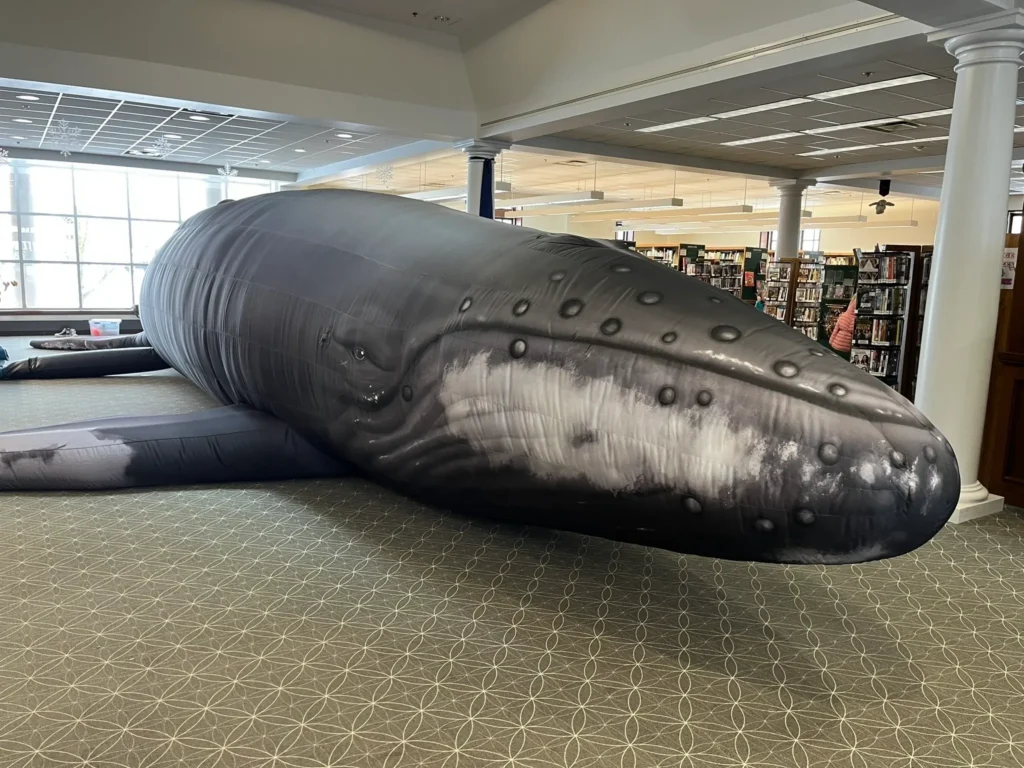
At The Whalemobile, we believe people protect what they understand—so we bring ocean science to life through stories, hands-on learning, and by bringing a life-sized whale in schools and libraries. To learn more about our programs, visit our website at www.thewhalemobile.com.