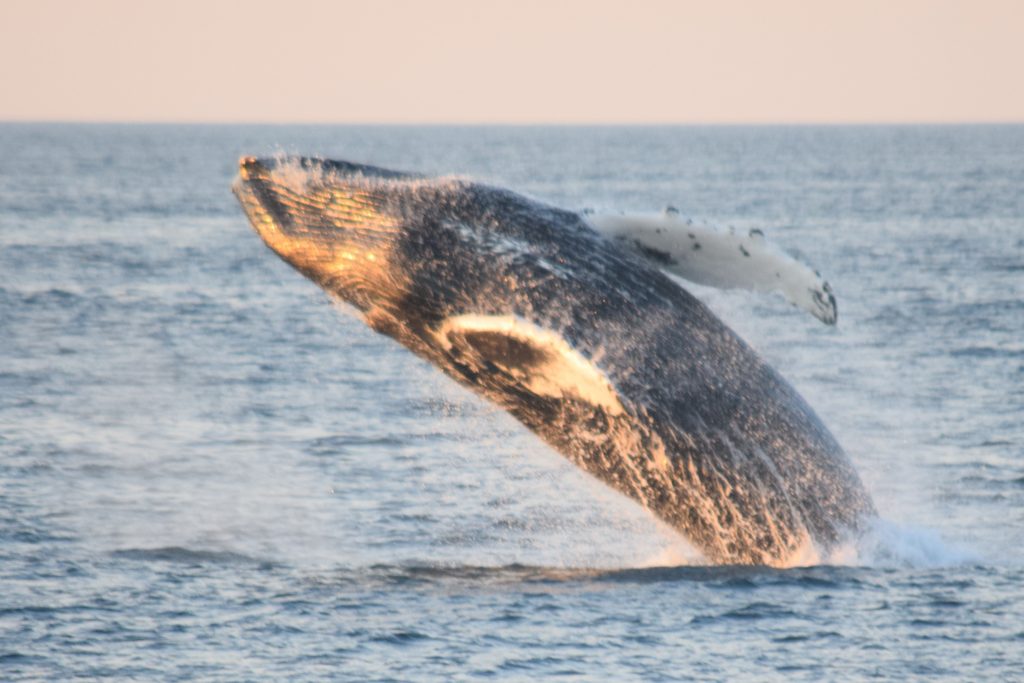
A year in the life of a humpback whale is marked by epic migrations and profound changes. During the months of April through late October, our humpback whales inhabit the nutrient-rich waters here in the Gulf of Maine, where they feed extensively on small schooling fish, krill, and plankton. These whales can consume 1-2 tons of food each day, storing fat reserves for their journey ahead. As winter approaches, the whales embark on one of the longest migrations in the animal kingdom, traveling thousands of miles to warmer tropical or subtropical waters, specifically to areas known as Silver Bank in the Dominican Republic and Salt Cay, Turks and Caicos. This journey, often lasting several weeks, is undertaken primarily for breeding and calving, where females give birth to their young in safer, predator-free environments.
In the warmer breeding grounds, the social dynamics of humpback whales shift. Male whales compete for the attention of females through complex and haunting songs, which can last for up to 20 minutes and be repeated for hours. Females, especially those with calves, are often accompanied by escorts, other whales that protect them and their young. During this period, humpbacks do not feed, relying solely on the fat stores accumulated in the feeding season. As spring approaches, the cycle begins anew, with mothers leading their calves back toward the Gulf of Maine ensuring the young whales learn the migratory routes they will follow for the rest of their lives.

Our Whalemobile Team works on whale watching boats that operate out of Gloucester and Newburyport, Massachusetts, which gives us the unique opportunity to explore two prominent feeding grounds in the Gulf of Maine: Stellwagen Bank and Jeffreys Ledge. Stellwagen Bank is a shallow underwater ‘sandbar,’ that is roughly 19 miles long and 6 miles wide. The depths range from about 80 to 100 feet, on the top, to much deeper waters, around 300 ft. around the sides. Jeffreys Ledge, on the other hand, is a long, sloping underwater ‘rocky mountain’ that extends about 33 miles NE from Gloucester and is 5 miles wide. The depths range from 150 on top to 600 feet deep around the edges. This change of depth is key to creating conditions for nutrient-rich upwellings. As the water currents hit the edges of the bank, they push cold, nutrient-laden water upward, fueling a productive food chain that supports an abundance of phytoplankton, zooplankton (like copepods and krill) and schooling fish, which in turn attracts the whales. Interestingly, the sandy bottom of Stellwagen often attracts sand eels whereas herring is the most common schooling fish found on the rocky bottom of Jeffreys Ledge.
When humpback whales migrate north, some are known to primarily remain on Stellwagen Bank, while others frequent Jeffreys Ledge. Certain individuals however, will travel between the two feeding grounds, adapting their movements based on the availability of food. With that being said, this 2024 season was full of changes and many surprises. Stay tuned to hear about the differences between Amanda and Cynde’s season with 7 Seas Whale Watch out of Gloucester and Kristin’s season with Newburyport Whale Watch out of Newburyport!
Watch our video about humpback whales!
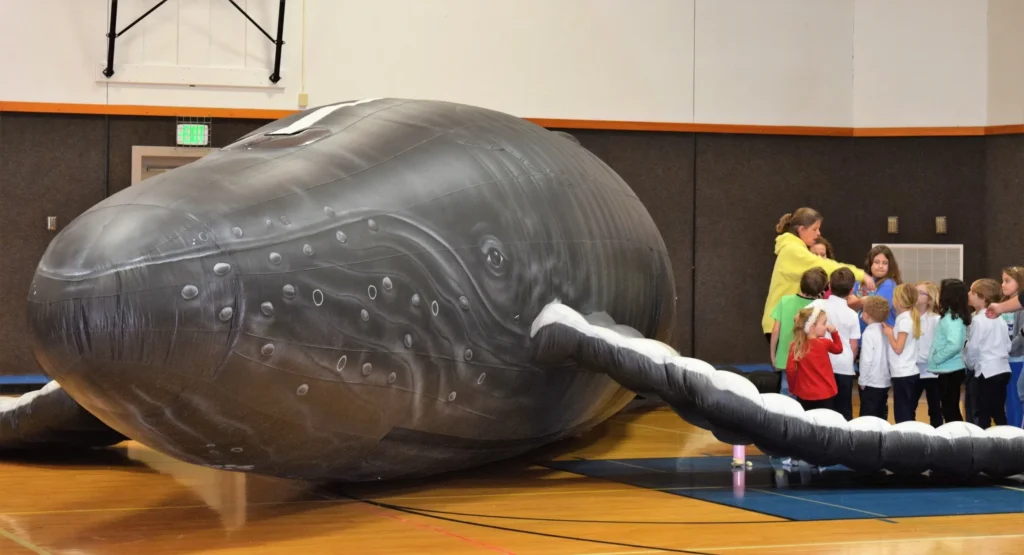
At The Whalemobile, we believe people protect what they understand—so we bring ocean science to life through stories, hands-on learning, and by bringing a life-sized whale in schools and libraries. To learn more about our programs, visit our website at www.thewhalemobile.com.