It’s a common misconception that all baleen whales exclusively eat plankton. While many baleen whales do consume large amounts of plankton, particularly krill, their diets are actually quite diverse and can include a variety of larger prey depending on the species. Baleen whales can be categorized as either specialists or generalists based on their feeding habits and the types of prey they target.
Specialists focus exclusively on specific prey. Blue whales, for instance, are considered krill specialists. Despite their massive size, they primarily consume vast amounts of tiny krill, often targeting specific areas with dense concentrations. The baleen whales we commonly see here in the Gulf of Maine (humpbacks, finbacks, and minke whales) are generalists. This means that they consume a wide range of prey. They feed on small schooling fish like herring and sand lance, as well as zooplankton such as krill and copepods. Their ability to switch between different food sources allows them to adapt to varying prey availability, making them more resilient to environmental changes. This generalist strategy is advantageous in dynamic ecosystems like Stellwagen Bank and Jeffreys Ledge, where prey types can fluctuate seasonally.
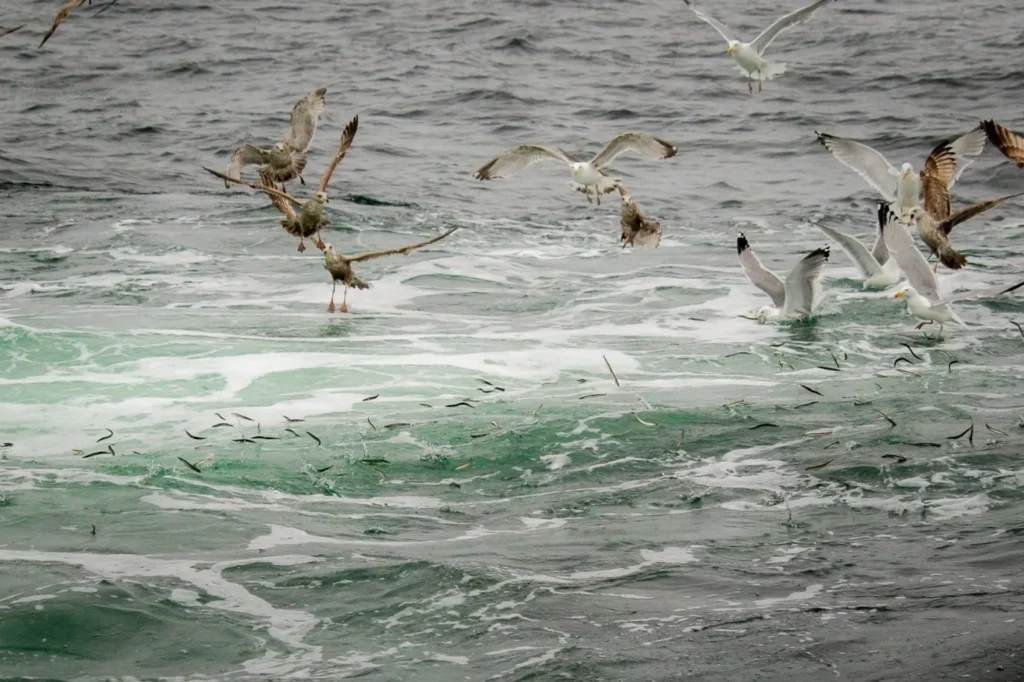
Schooling fish swim together in coordinated groups, moving in synchrony to improve their survival chances. This behavior allows fish to confuse predators, improve hydrodynamics, and increase their foraging efficiency. The tight formations they create provide protection from predators, as large groups make it harder for individual fish to be singled out. Many fish species, such as herring, sand lance, and mackerel, exhibit this schooling behavior.

Stellwagen Bank and Jeffreys Ledge are home to large populations of schooling fish, which are a crucial part of the marine ecosystem in these feeding grounds. Species like herring, sand lance, and mackerel dominate the area, forming dense schools that attract a wide range of predators. These fish are secondary consumers and integral to the food web, as they feed on smaller plankton and in turn become prey for top predators. On Stellwagen Bank, the upwelling of nutrient-rich waters supports large populations of sand lance, a small, elongated fish that buries itself in sandy substrates. Sand lance is a favorite food of humpback whales, which use unique foraging techniques such as bottom feeding and bubble nets to trap and consume these schools.
Jeffreys Ledge also boasts an abundance of schooling fish, particularly herring, which play a vital role in sustaining the marine predators in the area. Herring are rich in oil and protein, making them an important food source for not only whales, but also for sharks, tuna, and seabirds. The steep drop-offs of Jeffreys Ledge create ideal conditions for these fish to thrive, as the cold, nutrient rich waters rise to the surface, fueling phytoplankton blooms that support the herring populations. This dense concentration of fish makes Jeffreys Ledge a hot spot for whale activity, especially during the summer and fall months when feeding is at its peak.
In last week’s blog post, we discussed how some humpbacks are mainly seen on Stellwagen Bank where there is an abundance of sand lance, while others spend most of their time on Jeffreys Ledge, where there is a lot of herring. Some humpbacks on the other hand will go back and forth between the feeding grounds. It seems like these whales have preferences just like we do! Based on your own feeding habits, are you a generalist like the whales in the Gulf of Maine or a specialist like the blue whale?
Check out our video about schooling fish HERE!
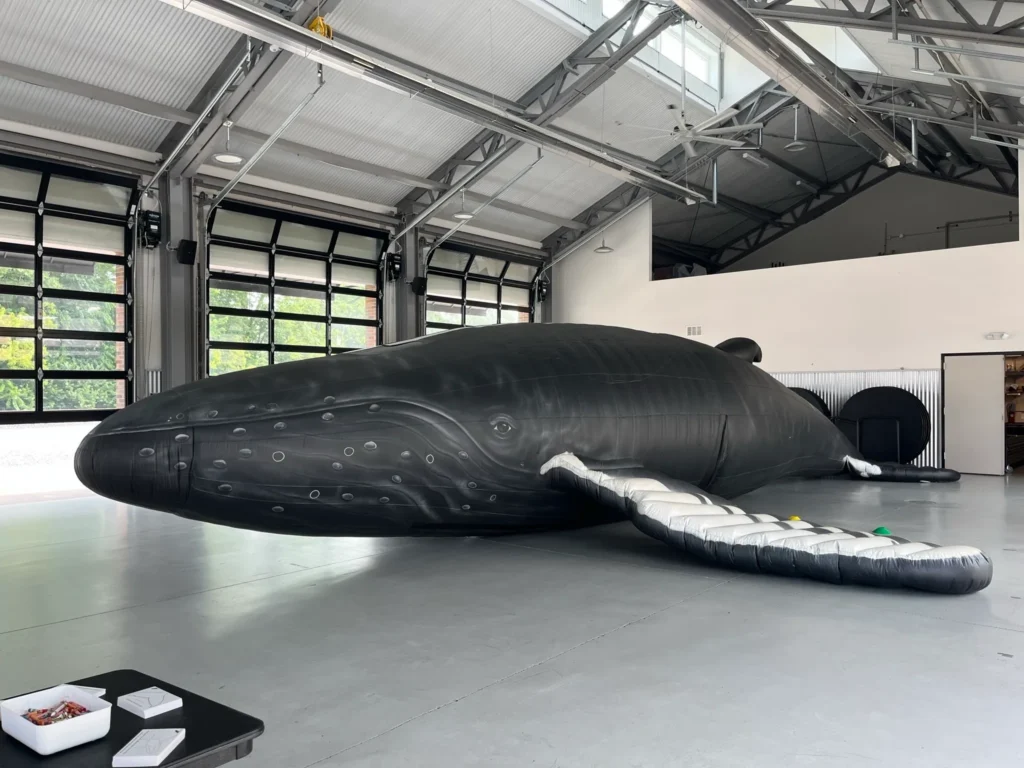
At The Whalemobile, we believe people protect what they understand—so we bring ocean science to life through stories, hands-on learning, and by bringing a life-sized whale in schools and libraries. To learn more about our programs, visit our website at www.thewhalemobile.com.