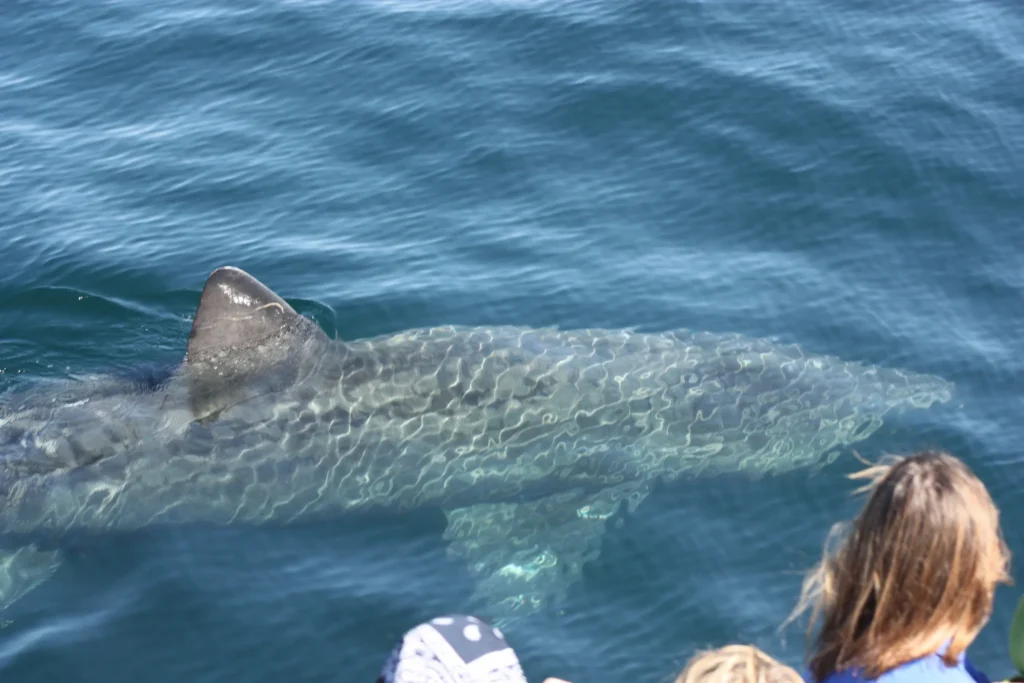
Imagine a shark so big it could be mistaken for a sea monster, yet all it wants to do is slurp up tiny plankton like an underwater vacuum cleaner! That may sound silly or ridiculous, but what if I told you there is a species of shark that fits this description? Meet the basking shark (Cetorhinus maximus) – the second largest fish on earth, which can grow to lengths of 40 feet long (that is longer than a school bus!) Basking sharks may look intimidating with their massive size and gaping mouths, but they are among the gentlest giants of the ocean.
Basking sharks belong to the class Chondrichthyes, a group of cartilaginous fishes that includes sharks, rays, and skates. The word Chondrichthyes is derived from Greek, meaning “cartilage fish” (chondros=cartilage, ichthys=fish), as their skeletons are made entirely of cartilage rather than bone. Does this word cartilage sound familiar? Touch the tip of your nose or your ear lobes…we also have cartilage in our bodies!

There are over 500 species of sharks in the world, ranging from the tiny dwarf lantern shark, just a few inches long, to the massive whale shark, which can grow over 60 feet. Among these, the basking shark (Cetorhinus maximus) is one of only three species of filter-feeding sharks, alongside the whale shark (Rhincodon typus) and the megamouth shark (Megachasma pelagios).
Basking sharks get their name because they often swim near the surface of the water, soaking up the sunshine like they’re basking at the beach. But they’re not sunbathing—they’re eating! These sharks cruise with their giant mouths wide open, filtering out tiny plankton from the water. They swim slowly through the water, straining tiny plankton through special structures in their gills called gill rakers. When water flows into their huge mouths, the gill rakers catch tiny creatures like krill and copepods and trap them, so the basking shark can swallow them. It’s like using a strainer to catch spaghetti while letting the water go through! A basking shark can filter up to 1.5 million gallons of water in one hour, that is enough water to fill TWO whole swimming pools!
Now, what about their teeth? Basking sharks actually do have teeth—lots of them—but they’re super tiny and not very useful. Scientists think their teeth might have been important a long time ago, but now these sharks don’t need them because they’re filter feeders. It’s like having a fork at dinner but only using a straw to sip soup! Together, their gill rakers and their nonfunctional teeth make basking sharks perfectly designed for their peaceful, plankton-eating lifestyle.
Basking sharks are usually grayish-brown or slate gray, and their backs may have a mottled pattern. This coloring helps them blend into the murky waters where they live, keeping them hidden from predators when they’re younger.
Basking sharks are ovoviviparous. This is a fancy way of saying the eggs hatch inside the mother’s body, and then she gives birth to live pups! Baby basking sharks are already big when they’re born—over five feet long, which is taller than most 5th graders!
Basking sharks are seasonal visitors to the Gulf of Maine, where they come to feed on the rich plankton blooms during the warmer months. They’re found in temperate oceans all around the world, from the cool waters of the North Atlantic to the southern hemisphere. In the Gulf of Maine, they’re most often seen near the surface, slowly cruising as they filter-feed. Their wide-ranging distribution means they can be spotted near coastlines or in open ocean areas, wherever the plankton is plentiful. In fact, this year was a big year for basking shark sightings during our whale watching season for The Whalemobile team. When we had a big influx of krill at the end of June-early July, Kristin saw two basking sharks, Nile the humpback whale, and 3 fin whales all feeding on the SAME patch of krill at the same time!
Learn about doctoral student Jaida Elcock with the MIT-WHOI program and her research on the movement ecology of basking sharks.

At The Whalemobile, we believe people protect what they understand—so we bring ocean science to life through stories, hands-on learning, and by bringing a life-sized whale in schools and libraries. To learn more about our programs, visit our website at www.thewhalemobile.com.