As you’ve been able to see throughout our weekly species highlight, the Gulf of Maine is home to some of the most incredible marine animals on the planet, all of which play vital roles in our oceans’ ecosystem. These organisms come in all shapes and sizes, some being microscopic (meaning they are too tiny for our eyes to see without special tools) while others are among the largest animals to ever exist.
Finback whales, more commonly known as “fin whales” (Balaenoptera physalus) are the second largest whale species on the planet, falling second only to the enormous blue whale. Fin whales can grow to lengths of around 70 to 75 feet. That’s two school buses long! These gentle giants weigh 50-70 tons. Known for their streamlined bodies and unbelievable speeds, fin whales are often referred to as the “greyhounds of the sea” with the ability to reach speeds of 20-30 miles per hour! Cynde remembers a day years ago where the fin whale was porpoising and we couldn’t keep up with it on our whale watch boat.

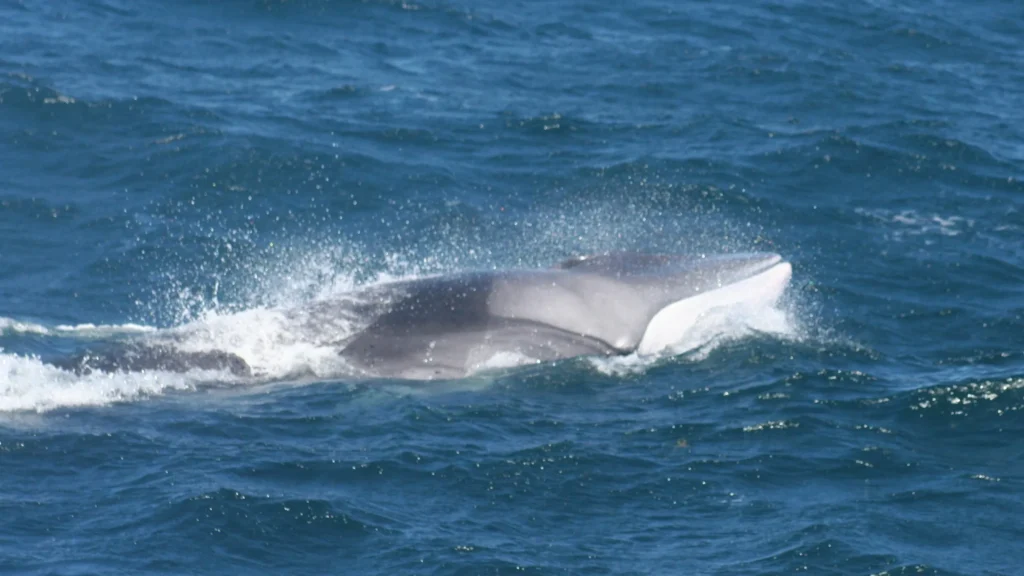
While their sheer size is a magnificent sight in and of itself, fin whales have a coloration just as stunning. They are generally dark along their backs in contrast to a lighter underside (countershaded), but a closer look shows that these animals have a unique asymmetrical pigmentation along their head. Their lower left jaw and baleen is dark in appearance while their right jaw and baleen is much lighter, sometimes even pure white. They also have a “blaze and chevron” pattern along their head, near the blowhole, which is bands of different shades of gray. Similarly to how the black and white patterns on the underside of a humpback’s tail can be used for individual identification, blaze and chevron patterns along with dorsal fins can be used to tell individual fin whales apart.
Like other baleen whales, fin whales use baleen plates, made of keratin, to strain their prey from the water. Fin whales are lunge feeders, meaning they open their mouths and swim (often on their sides) through dense patches of prey to gather their meals. Off the coast of Ma, we have seen these whales feed on all kinds of schooling fish (sand eels, herring and mackerel) as well as krill and copepods. Just like the humpbacks, fin whales have accordion-like pleats (ventral pleats or grooves) on the underside of their mouth that expand to allow them to take in huge volumes of seawater teeming with food.
Fin whales can be found in all of the world’s oceans, particularly offshore in temperate and polar regions where upwelling causes food sources to be abundant. Despite their massive size, scientists haven’t been able to track specifically where our Gulf of Maine fin whales go in the winter. It is thought that fin whales move to warmer waters to have their calves–similar to humpbacks. We just don’t know which warmer waters specifically! Isn’t it funny to think that one of the largest animals to ever exist is one we know so little about?
While humpback whales tend to be the draw for most whale watch passengers in the Gulf of Maine, fin whale sightings are among some of The Whalemobile Team’s favorites! Fin whales are massive, magnificent marvels that we are lucky enough to spend time with here.
In the Gulf of Maine, Blue Ocean Society for Marine Conservation researches fin whales off the coast of MA and NH. Click here to see a video of Dianna Schulte, co-founder and Director of Research, speaking about how we identify fin whales.
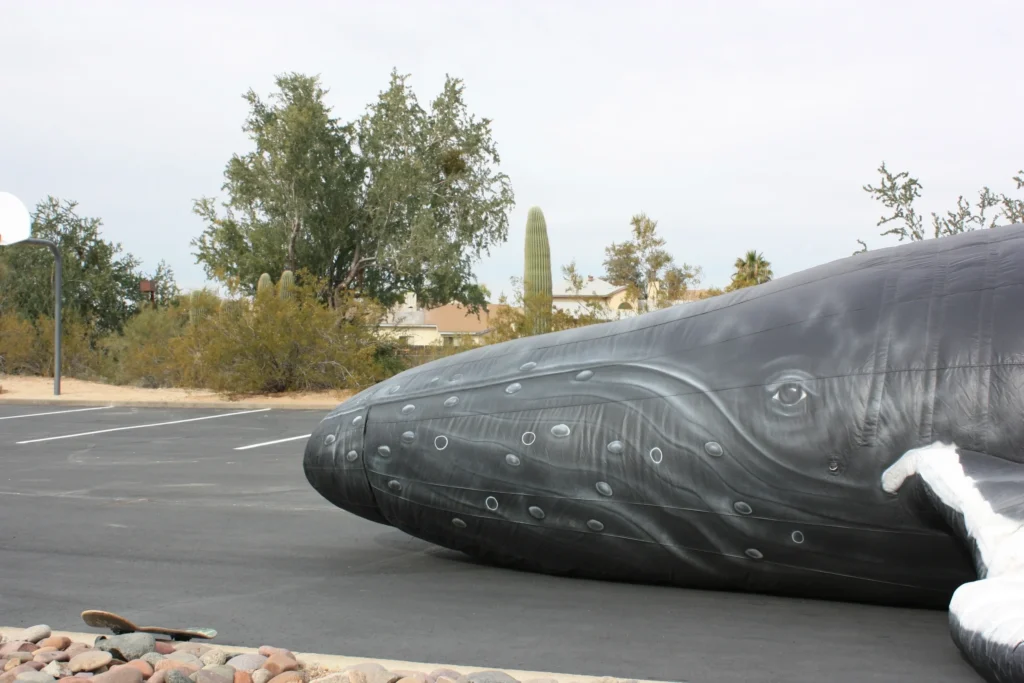
At The Whalemobile, we believe people protect what they understand—so we bring ocean science to life through stories, hands-on learning, and by bringing a life-sized whale in schools and libraries. To learn more about our programs, visit our website at www.thewhalemobile.com.